If you have priced a new laptop or phone recently and quietly winced, you are not imagining it. Prices across nearly every category of computer and device have climbed sharply in 2026, and the usual suspects — inflation, tariffs, a weak season — are not the main culprit. The real driver is the artificial intelligence boom, and specifically the 2026 RAM shortage it has triggered.
In short, the enormous data centers powering AI are buying up memory chips faster than the industry can make them, leaving far less supply for the phones, laptops, and PCs that ordinary people buy. The result is the steepest run-up in memory prices in living memory, and it is showing up on price tags everywhere from budget laptops to game consoles.
This advisory explains, in plain terms, what is actually happening, how much more you are paying, a sneaky tactic to watch out for when shopping, how long this is likely to last, and — most importantly — how to buy smart while it plays out.
What Is Causing the 2026 RAM Shortage?
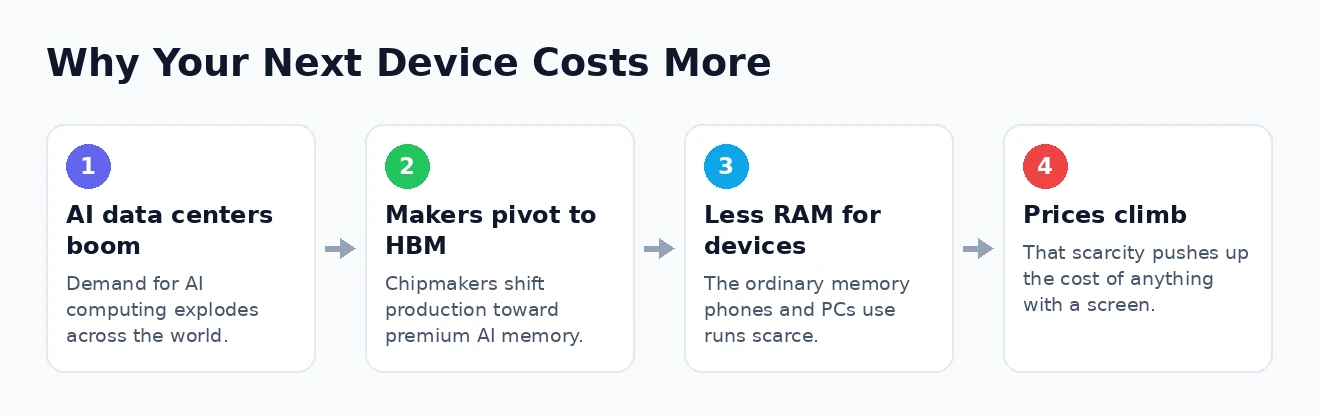
The root cause is a deliberate shift in what memory factories choose to produce. Modern AI accelerators — the specialised chips inside AI data centers — rely on a premium type of memory called high-bandwidth memory, or HBM. It is far more profitable than the ordinary memory in your laptop, so the three companies that make almost all of the world’s memory, Samsung, SK Hynix, and Micron, have been redirecting their production lines toward it as fast as they can.
The problem is that making HBM is enormously resource-intensive. Producing a single unit of it means giving up several units of the conventional memory that phones and computers use, so every wafer devoted to AI is a wafer taken away from consumer devices. By some estimates, AI will swallow around a fifth of all memory production in 2026, and at least one major maker has described itself as effectively sold out for the year.
The knock-on effect is simple supply and demand. With the memory left over for consumer gadgets suddenly scarce, its price has soared — and because memory sits inside almost everything with a screen, that increase ripples out across the whole market. The Tom’s Hardware website has resources you may find useful if you want to follow the pricing data in detail.
How Much More Are You Actually Paying?
The numbers are genuinely striking. Analysts have tracked laptop prices from major brands like Dell, HP, and Lenovo rising somewhere between 15% and 30% over the course of 2026. Underneath that, the raw price of DRAM — the main system memory — roughly doubled in the first quarter of the year alone, with further sharp rises after. Memory now makes up around a third of what it costs to build a laptop, up from well under a fifth historically.
Forecasts for the finished products are sobering. Depending on which analyst house you follow, PC prices are expected to climb somewhere between roughly 8% and 17% for the year, with smartphone prices up around 13%. If you build your own desktop, the sticker shock is even sharper: a common 32GB memory kit that sold for well under a hundred dollars in early 2025 was fetching several hundred by early 2026.
Crucially, this is not just a computer story. The same memory chips sit inside phones, tablets, televisions, game consoles, and smart-home gadgets, so a shortage in one place shows up on every shelf. Nintendo raised the price of its Switch 2 partway through the year and pointed directly at higher memory costs, and other console makers followed. If it has a screen and a processor, the 2026 RAM shortage has almost certainly touched its price. The Consumer Reports website has resources you may find useful on how this is affecting specific product categories.
The Sneaky Part: Watch for Shrinkflation
Here is the twist that catches people out. Manufacturers know shoppers recoil at a higher price tag, so rather than raise prices, some are quietly cutting what you get for the same money — a tactic often called shrinkflation. The price stays familiar; the product gets worse.
In plain terms, that $600 laptop you buy this year might look identical to last year’s model, but under the hood it could have 8GB of memory instead of 16GB, a dimmer screen, or slower storage. The label looks the same; the machine is quietly weaker.
Smartphones are seeing the same squeeze. Analysts have reported average phone prices creeping up while components like cameras, displays, and audio are quietly downgraded on some models to hold the line on cost. Budget phones and laptops are also being dropped from lineups altogether, because they are the hardest to build profitably when memory is this expensive. The practical takeaway is to never judge a device by its price alone this year — read the full specification sheet, and compare it carefully against last year’s equivalent before assuming you are getting the same thing.
How Long Will This Last?
This is not a passing blip that will resolve in a month or two. The companies that make memory have openly warned that the shortage is likely to deepen before it eases, with one describing 2027 as potentially the worst year of the crunch. Most forecasts expect elevated prices to persist through 2027 at least, and some analysts suggest the tight market could linger toward the end of the decade.
The reason is that you cannot simply build a memory factory overnight. New manufacturing capacity is not expected to come online in a meaningful way until 2027 or 2028, and until it does, AI demand will keep competing with consumers for a limited pool of chips. In other words, the supply side has no quick fix on the horizon.
There is one flicker of good news: the breakneck price increases did begin to slow in the latter part of 2026. But it is worth understanding why. That cooling is happening largely because ordinary shoppers have simply hit the ceiling of what they can afford, forcing manufacturers to stop passing on every increase — not because supply has recovered. Prices are stabilising at a high level, not falling back to where they were.
Should You Buy Now or Wait?
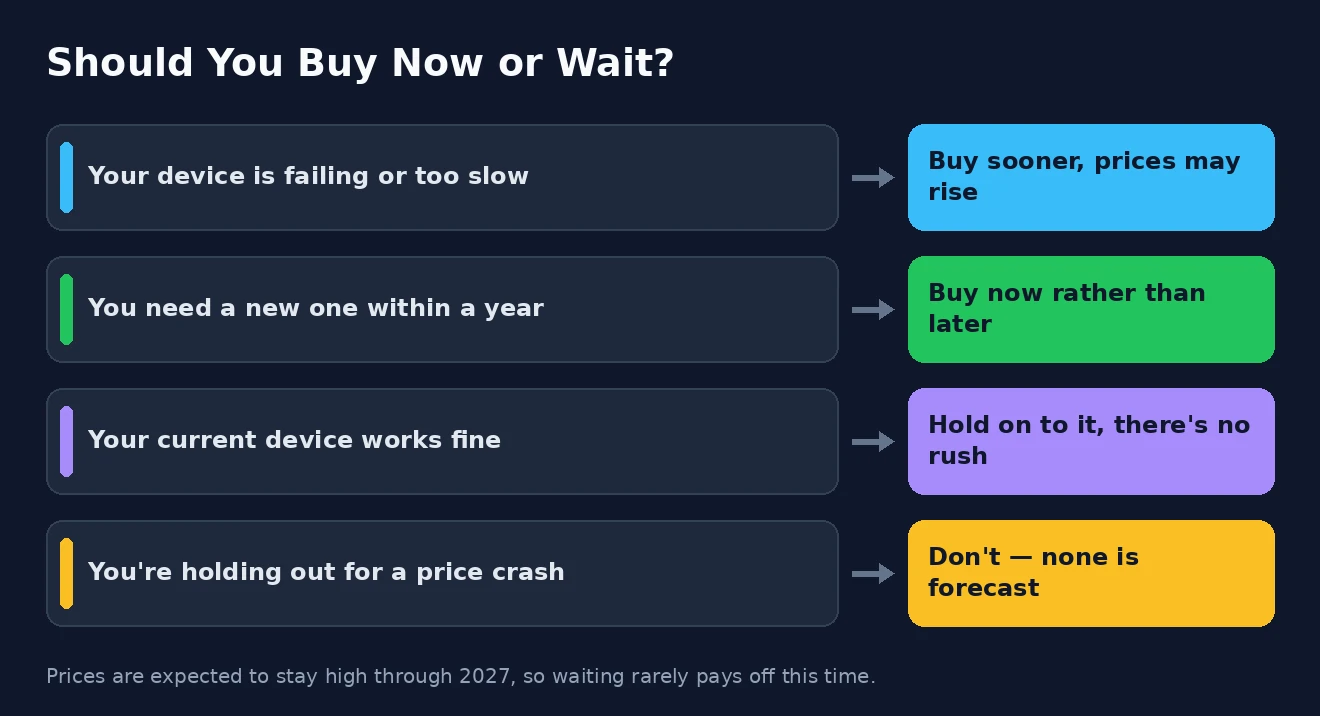
Given all of that, the instinct to wait for prices to drop is understandable — but it is probably the wrong bet. With the shortage forecast to run for years and no sign of memory prices returning to 2025 levels any time soon, holding out for a bargain could mean waiting a very long time and paying more in the meantime as any remaining older stock sells through.
So the sensible rule of thumb is this. If you genuinely need a new device in the next year or so — your current one is failing, or no longer does what you need — buying sooner rather than later is generally the wiser move, because prices are more likely to rise than fall. If, on the other hand, your existing phone or laptop is working perfectly well, there is no reason to rush out and upgrade; simply hold on to it and get more life out of it. What does not make sense is deferring a genuine need in the hope of a price crash that forecasters do not expect to come.
If you do decide to keep your current machine going, it is worth making it run as well as it can. Clearing out clutter with our guide to managing disk space on Windows 11, taming a system that is using too much memory, and generally speeding up Windows 11 can add a surprising amount of usable life to hardware you already own.
How to Buy Smart During the Shortage
If you are in the market for something new, a few practical habits will help you get the most for your money while memory stays expensive. None of this is complicated, but it matters more now than it has in years.
- Read the specs, not just the price. Compare the memory, storage, screen, and camera against last year’s model at the same price. If anything has quietly shrunk, you are seeing shrinkflation in action.
- Buy the memory and storage you need up front. Many phones and thin laptops cannot be upgraded later at all, and where you can upgrade, doing it now will only get pricier. It is usually better to pay once than to be stuck short.
- But do not overbuy either. Work out what you actually need — 8GB is fine for light web and email use, 16GB suits most people comfortably, and 32GB or more is really for gaming and creative work. Paying for memory you will never use is wasteful, especially at today’s prices.
- Consider last-generation and refurbished. Older standards and certified refurbished machines can sidestep some of the worst price rises, and a well-chosen previous-generation model is often plenty for everyday tasks.
- Shop around and be patient for the right deal. Prices and promotions vary a lot between retailers right now, so it pays to compare and to wait for a genuine sale rather than buying the first option you see.
It is also worth remembering that a slightly older or cheaper device is not a downgrade if it does everything you need. The pressure to buy the newest, most powerful machine has always been a little manufactured, and in a year like this it is worth resisting. If your needs are modest, a modest device bought sensibly will serve you just fine — and if your current one still works, the cheapest option of all is to keep it running well.
The 2026 RAM Shortage: Frequently Asked Questions
Why are laptops and phones more expensive in 2026?
Because AI data centers are buying up the memory chips that phones and computers also need. To feed AI, chipmakers have shifted production toward premium memory for AI accelerators, leaving less conventional memory for consumer devices and driving its price sharply higher — which shows up as higher prices on nearly everything with a screen.
How much have memory prices actually gone up?
A great deal. The core system memory roughly doubled in price early in 2026, and finished devices have followed, with laptops up somewhere between 15% and 30% and forecasts pointing to PC prices rising by up to around 17% and phones by roughly 13% for the year.
Should I buy a laptop now or wait for prices to drop?
If you genuinely need one within the next year, buying sooner is generally the better bet, because the 2026 RAM shortage is expected to keep prices high rather than let them fall. If your current device still works well, there is no urgency to upgrade — but do not defer a real need hoping for a price crash that analysts are not predicting.
When will device prices go back to normal?
Not soon. Memory makers expect the shortage to persist through 2027 and possibly longer, since new factory capacity will not arrive in force until 2027 or 2028. Prices began to stabilise in late 2026, but at a high level, because shoppers reached their limit — not because supply recovered.
The 2026 RAM shortage is an unusual situation, but the response is refreshingly simple. Understand that higher prices and quietly weaker specs are here for a while, read the fine print before you buy, get the memory and storage you truly need, and keep whatever you already own running as long as it serves you. Do that, and you will navigate this expensive stretch far better than the shopper who buys on the sticker price alone.