Picture the phone ringing and hearing your daughter’s voice, crying, saying she has been in an accident and needs money right now. Every instinct says to help. But increasingly in 2026, that voice is not your daughter at all — it is an artificial copy a scammer built from a few seconds of audio. AI voice cloning scams have become one of the fastest-growing frauds in the country, and they are frighteningly effective.
The reassuring news is that these scams, however sophisticated, are beaten by simple habits rather than clever technology. In this advisory I will explain how AI voice cloning scams work, why they are so convincing, and the practical steps — including one free defense that stops them cold — that will protect you and your family.
What Are AI Voice Cloning Scams?
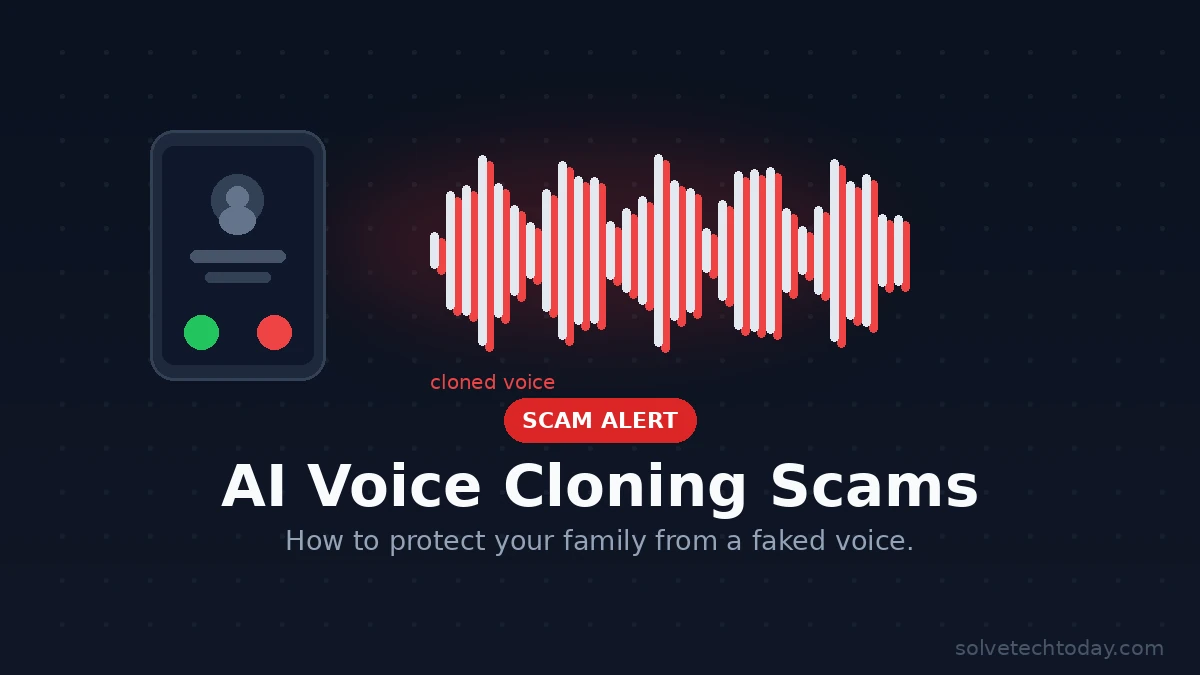
An AI voice cloning scam is a fraud in which criminals use artificial intelligence to imitate a real person’s voice, then use that fake voice to trick you into sending money or sharing information. Most often the cloned voice belongs to a family member, but the same trick impersonates a boss demanding an urgent payment or a bank calling about your account. The goal is always to exploit your trust in a familiar voice.
What has made these scams explode is how cheap and fast the technology has become. Where cloning a voice once needed long recordings and skill, today just a few seconds of audio produces a usable copy, and the tools are everywhere. Scammers harvest that audio from the videos, voicemails, and clips people post publicly, so almost anyone with an online presence can have their voice copied without ever knowing.
The scale is sobering. Americans lost on the order of hundreds of millions of dollars to AI-assisted scams in the past year, according to the FBI, and voice cloning attempts have surged, with reports suggesting the volume more than quadrupled in a single year. It is now among the fastest-growing categories of fraud, and much like the QR code scams we covered recently, it is a modern twist on an old con.
How an AI Voice Cloning Scam Works
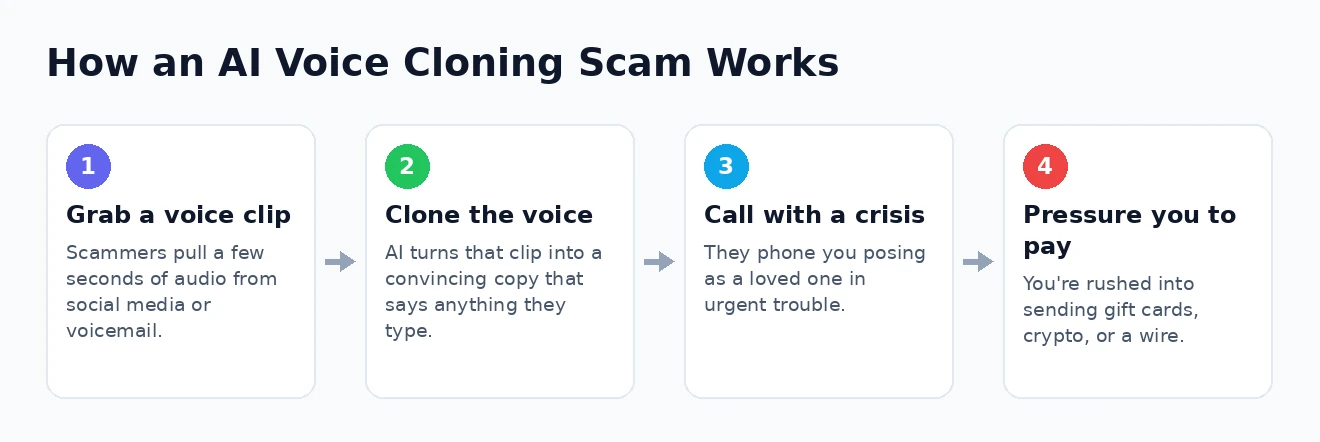
These scams follow a consistent pattern, and understanding the steps makes them far easier to stop. A typical AI voice cloning scam unfolds in four stages.
- They grab a voice sample. A few seconds of the target’s voice, usually from a public social media video or a voicemail greeting.
- They clone the voice. That sample is fed into an AI tool that can then say whatever the scammer types.
- They call with a crisis. Using the cloned voice, they phone a family member with an urgent, frightening story — an accident, an arrest, a stranded emergency.
- They pressure you to pay fast. They demand money immediately and untraceably, through gift cards, cryptocurrency, or a wire, and often insist you keep it secret.
The classic version is the “family emergency” or grandparent scam, updated with terrifying realism: instead of a stranger pretending to be your grandchild, you hear your grandchild’s actual cloned voice. The same structure powers fake “virtual kidnapping” ransom calls and business scams where a cloned executive orders staff to wire funds. In every case, the emotional shock and manufactured urgency are the real weapons, not the technology.
It is worth being honest about why sensible people fall for this. The voice is real — it genuinely sounds like your loved one, because it was built from their real voice, and studies find people identify a clone correctly only around sixty percent of the time. The usual red flags are gone, too: caller ID cannot help you, since spoofing a familiar number is cheap and easy, and the tell-tale bad grammar of old scams is absent because AI writes and speaks fluently. Crucially, you cannot rely on a “deepfake detector” app either, as these perform poorly against the newest tools.
The One Defense That Always Works: A Family Code Word
If you take away a single thing from this advisory, make it this: agree on a family code word. It is the most effective defense against voice cloning scams, it is endorsed by the FBI, and it costs nothing. Choose a specific, memorable word or phrase that your close family shares privately and never posts online.
An AI can perfectly mimic a voice, but it cannot know a secret that was never shared digitally. Ask an alarming caller for the code word: your real family member knows it instantly, while a scammer — however convincing the voice — will stall or fail. That one question cuts through even a flawless clone.
Choose something uncommon that would not appear online — not a pet’s name or a birthday, which are easily found, but something arbitrary and private. Share it verbally with the people who matter, agree it will verify any emergency call, and make sure older relatives and children understand it too. Setting this up over one family dinner may be the most valuable security measure you ever take.
What to Do If You Get a Suspicious Call
Even without a code word, a calm response defeats these scams. The instinct they exploit is the urge to act instantly, so the whole game is to slow down and verify. If a call feels frightening and urgent, work through these steps first.
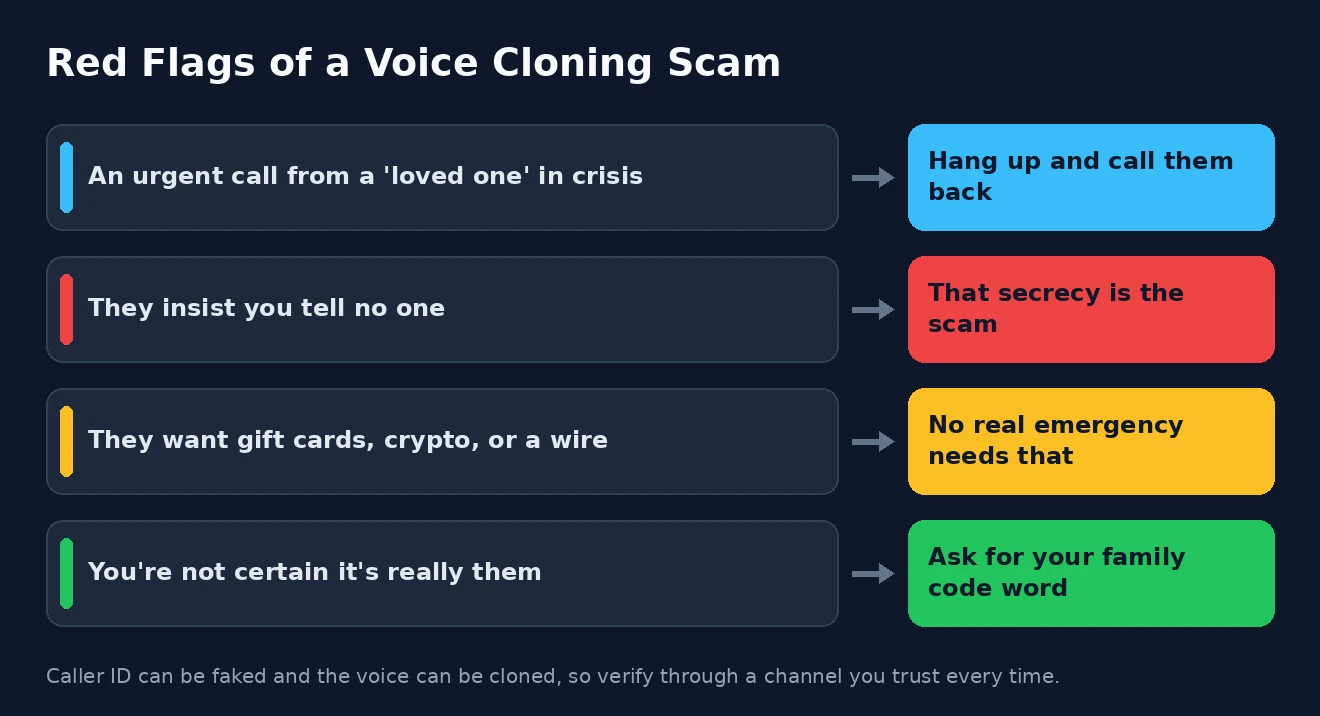
- Hang up and call back. Dial your family member directly on the number you already have saved. If the emergency is real they will answer; if it was a scam, you will reach them safe. This step alone stops the vast majority of losses.
- Refuse to be rushed. Say “I’ll call you right back” and do so. Genuine emergencies survive a two-minute pause; scams do not.
- Treat demands for secrecy as a red flag. A caller insisting you tell no one is manipulating you, not protecting anyone.
- Be suspicious of untraceable payments. Gift cards, cryptocurrency, and wire transfers are the hallmark of fraud — no real emergency requires them.
- Never share one-time codes. No genuine family member, bank, or official will ask you to read out a verification or two-factor code by phone.
The same caution applies to video calls, which can now be faked in real time: if something feels off, verify the person through a separate channel before acting. When in doubt, trust your unease over the voice on the line, and take the extra minute to confirm — the same instinct that helps against ordinary phishing scams applies here.
Protect Yourself Before the Call Comes
The strongest position is to prepare before a scammer ever dials. Beyond agreeing on a code word, the most useful step is to be mindful of how much of your voice and image is public, because criminals cannot clone what they cannot find.
Tighten the privacy settings on social media so your videos and voice clips are not open to the whole world, and encourage your family to do the same — this matters especially for the many clips people post of their children. Have a direct conversation with relatives at both ends of the age range, too, because this is not only a threat to the elderly: data shows younger, phone-native adults are actually targeted more often, even though older victims tend to lose more per incident. Keeping your phone secure and guarding your online identity round out a sensible defense.
If the worst happens, act quickly and without shame — anyone can be caught out, and speed matters more than embarrassment. Stop any pending payments, contact your bank at once, and report the incident. In the United States you can report to the FTC website and the FBI Internet Crime Complaint Center website, both of which have resources you may find useful for reporting the fraud and helping investigators track it.
AI Voice Cloning Scams: Frequently Asked Questions
How much audio do scammers need to clone a voice?
Very little. Modern tools can produce a recognizable clone from only a few seconds of someone speaking, and a longer sample makes it more convincing still. That audio is usually taken from public social media videos, voicemail greetings, or any clip posted online.
Can I tell a cloned voice from the real thing?
Often not reliably. Studies show people identify cloned voices correctly only around sixty percent of the time, and the technology keeps improving. Never rely on spotting the fake by ear — verifying through a callback or a family code word is far more dependable.
What should I do if I already sent money?
Act immediately. Contact your bank or card provider to try to stop or reverse the payment, gather the details of the call, and report it to the FTC and the FBI’s Internet Crime Complaint Center. Move fast, and do not let embarrassment delay you.
Are only older people targeted by these scams?
No. While seniors are heavily targeted and often lose more per incident, younger adults are actually targeted more frequently. These scams threaten every age group, which is why a family-wide plan and a shared code word matter for everyone.
AI voice cloning scams are an alarming development, but they are not unbeatable. Agree on a family code word, hang up and call back when a call feels urgent, refuse to be rushed into untraceable payments, and limit how much of your voice sits online. Do those things, and even a perfect copy of a loved one’s voice loses its power — because the one thing the machine can never fake is a secret you kept to yourselves.