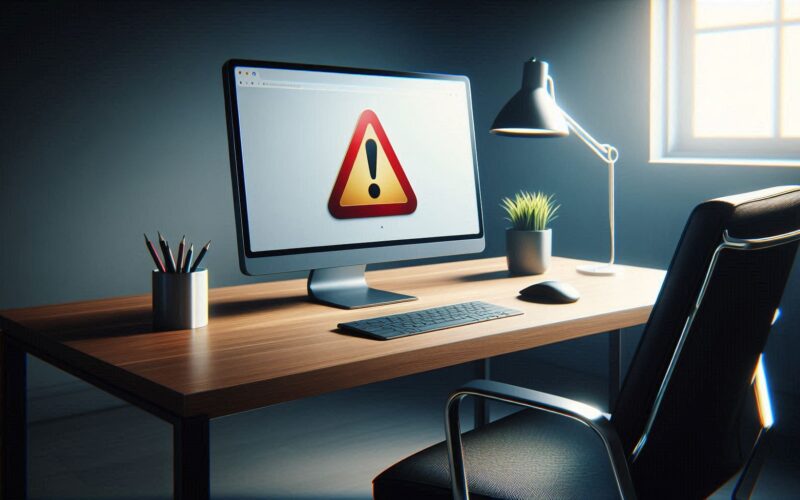
A Chrome tab crashing — “Aw, Snap!” or “Out of Memory” error, tab going grey and unresponsive, or specific sites always crashing while others work fine — has a different set of causes than Chrome itself crashing. Understanding which layer is breaking tells you where to look. We go deeper on the whole subject in our Google Chrome Errors.
The most important immediate observation: is it one specific tab (or one specific site) that always crashes, or is it random tabs across different sites? Site-specific crashes point to that site’s content (heavy JavaScript, specific codec, memory hog). Random crashes across different sites point to Chrome’s memory management or a broken extension.
Chrome’s memory situation
Each Chrome tab runs in its own process. When system RAM gets low, Chrome starts killing tabs to free memory — the “Aw, Snap!” message you see when you return to a tab that was discarded. This isn’t a crash exactly; it’s Chrome’s memory management doing its job aggressively.
Check how much RAM Chrome is consuming: Chrome’s own Task Manager (Shift+Esc while Chrome is open) shows memory usage per tab and extension. Sort by Memory column. If the total is within 1-2GB of your system RAM: you’re memory-constrained. The tab that crashes is usually the one that just pushed Chrome over the edge.
Quick relief: close tabs you’re not using, especially video tabs (YouTube, Netflix, Twitch) which can each consume 300-600MB. Audio-playing tabs are invisible memory hogs — a web radio tab can hold 200MB while showing nothing.
Extensions consuming memory and causing crashes
Extensions run in Chrome’s process space and can destabilise specific tab rendering. If a tab crashes consistently: open it in Incognito (Ctrl+Shift+N) which runs without extensions. If it loads fine: an extension is the cause. Back in normal Chrome, disable extensions one at a time (chrome://extensions) to find the offender.
Extensions that commonly cause tab crashes:
- Ad blockers with aggressive rules (sometimes break JS execution on specific sites)
- Translation extensions (heavy processing on text-heavy pages)
- Video downloaders (conflict with site’s video player JavaScript)
- Security extensions that scan page content inline
Finding the offending extension is usually enough — you don’t have to remove it. Add the crashing site to the extension’s whitelist/exclusion list instead. Most blockers let you pause on a per-site basis by clicking the extension icon → toggle off for this site.
Hardware acceleration and GPU rendering
Chrome offloads rendering to the GPU when “Use hardware acceleration when available” is enabled. When the GPU driver has a bug or crashes during render: you see the tab crash rather than a GPU error. This is especially common after recent NVIDIA or AMD driver updates.
Test: chrome://settings → System → “Use hardware acceleration when available” → toggle off → Relaunch Chrome → test the previously-crashing tab. If it stays stable: hardware acceleration was the issue. Update the GPU driver from the manufacturer’s site (not Windows Update), then re-enable acceleration. Don’t leave it off permanently without trying the driver update — hardware acceleration meaningfully benefits performance on modern systems.
The site itself
Some websites are genuinely very heavy — crypto price tickers, news sites with 40+ tracking scripts, complex web apps with poor memory management. A site crashing Chrome isn’t always Chrome’s fault. Test the same site in Firefox or Edge. If it crashes there too: the site is the problem, not Chrome specifically.
For sites you need to use but that crash: reduce their impact. Click into the site → site settings (lock icon in address bar) → disable JavaScript (breaks functionality but prevents crashes for diagnosis) → if the tab stays stable: a specific script is crashing. No clean fix here beyond waiting for the site to optimise, or reporting the issue to the site owner.
Our guide on Chrome stability troubleshooting covers the cases where Chrome itself (not just a tab) is crashing, and our Chrome page loading covers related issues where pages fail to load rather than crashing the tab. For Chrome’s memory management configuration and flag options, Google’s Chrome documentation covers the memory-saving and tab-discard settings.
Chrome flags that affect memory and stability
Chrome’s experimental flags (chrome://flags) include memory management options that can reduce tab crashes:
- “Memory Saver” (chrome://settings → Performance → Memory Saver): Chrome automatically puts inactive tabs to sleep. Reduces total memory usage significantly at the cost of tabs needing to reload when revisited. Good for systems with 8GB RAM or less.
- chrome://flags/#enable-tab-discard: more aggressive tab discarding when memory is tight. Tabs are suspended rather than crashed — you see a “Tab was discarded” message when returning, which is recoverable.
- chrome://flags/#renderer-code-integrity: if a specific antivirus or security tool is conflicting with Chrome’s rendering process, disabling this flag (setting to Disabled) can resolve crashes caused by code injection into Chrome’s renderer. Re-enable if stability doesn’t improve — this flag exists for a security reason.
Memory Saver is the most broadly useful of these. It ships as a standard Chrome feature now rather than a flag in newer versions — check chrome://settings → Performance first.
Renderer process limit
By default, Chrome creates a new renderer process for each site (or group of related sites). On machines with limited RAM, you can tell Chrome to use fewer processes by sharing renderers across tabs:
Create a Chrome shortcut → right-click → Properties → Target field → add --process-per-site at the end of the path (after the closing quote). Example: "C:Program FilesGoogleChromeApplicationchrome.exe" --process-per-site. Launch Chrome from this shortcut — tabs from the same site now share a renderer process, reducing total memory footprint.
Trade-off: if one tab from a site crashes, all tabs from that site might crash together. Better stability per-site, worse isolation between instances of the same site. For most users, Chrome’s default (one process per site, per frame) is the right choice, but on severely memory-constrained machines this helps.
Video and codec crashes
Tabs showing video — especially 4K or HDR video — crash when the codec encounters an incompatible stream or when hardware video decoding fails. Symptoms: video tab crashes specifically while playing, not on static pages.
Test: reduce video quality to 720p on the crashing video. If it plays at 720p but crashes at 4K: hardware video decoding at high resolution is the issue. chrome://settings → System → “Use hardware acceleration when available” → toggle off → test again. If stable without hardware acceleration: update GPU driver and re-enable.
Also check: chrome://gpu → scroll to “Video Decode” section → if it shows “Software only, hardware acceleration unavailable”: Chrome already determined hardware decode isn’t working and fell back to software. This is slower but should be stable. If video tabs still crash with software decode: the content itself (specific codec, DRM-protected stream, corrupted video) is the issue, not Chrome’s decode path.
Profile and cache corruption
If specific tabs crash consistently only in your main Chrome profile but not in a Guest profile or Incognito: the main profile has corruption. Temporary fix: use Incognito for the crashing sites. Permanent fix: reset Chrome profile data.
Test in a new profile: Chrome menu → profile icon → Add → continue without account → navigate to the crashing site. If stable in new profile: your main profile is corrupted. Options:
- Reset (softer): chrome://settings/reset → “Restore settings to their original defaults” — clears extensions and settings but keeps bookmarks and passwords
- New profile (clean): sign in to Chrome Sync on the new profile to restore bookmarks and passwords; start using the new profile as your main one
- Cache clear (quickest attempt): Ctrl+Shift+Delete → Cached images and files + Cookies → Last 4 weeks → Clear — this sometimes resolves cached corrupted content causing render crashes
System RAM issues
Rarely but occasionally, random Chrome tab crashes indicate a hardware memory fault rather than a software issue. Signs: crashes happen across many different sites with no pattern, tabs crash in both normal and Incognito mode, the issue started suddenly without any software change.
Test: Windows Memory Diagnostic. Win+R → mdsched → “Restart now and check for problems.” This scans RAM during boot and reports errors. If errors are found: one of your RAM modules is failing. Open the PC → try each stick individually to identify the bad one → replace it.
RAM failures are the last thing to check but worth knowing about — Chrome is typically the first app to exhibit stability issues when RAM is failing because it aggressively uses available memory and pushes marginal RAM modules past their tolerance.
| Crash pattern | Most likely cause | First fix |
| One site always crashes, others fine | Site content or extension conflict | Test in Incognito; disable extensions for that site |
| Random tabs crash with “Aw, Snap!” | Low memory (RAM full) | Close unused tabs; enable Memory Saver; add RAM |
| Video tabs crash specifically | Hardware acceleration codec issue | Reduce quality; disable hardware acceleration; update GPU driver |
| Crash after GPU driver update | Driver incompatibility | Disable hardware acceleration; roll back or update driver |
| Works in new profile, crashes in main | Profile corruption | Clear cache; reset Chrome settings; or switch to new profile |
| Random crashes across all sites | Possible RAM fault | Run Windows Memory Diagnostic; test RAM modules individually |
The Incognito test is the fastest way to split extension issues (biggest category) from everything else. RAM-related crashes (second biggest) reveal themselves through the pattern of random sites crashing with no consistency. Hardware acceleration issues follow GPU driver changes reliably. Once you know the pattern, the fix is usually clear.
Chrome task manager as your main diagnostic tool
Shift+Esc opens Chrome’s built-in Task Manager — separate from Windows Task Manager. It shows every tab, extension, and background process, with CPU%, Memory, and network usage per item. This is the most useful starting point for understanding tab crashes because you can watch resource usage in real time while the tab that tends to crash is open.
Look for: a tab that shows abnormally high CPU (consistently above 50%) or memory (consistently above 500MB-1GB) is a candidate for crashing when resources get tight. An extension showing high CPU that you don’t need: disable it. A background page (from an extension) consuming memory continuously: that extension needs to be updated or removed.
Chrome also shows “Crashed” next to any processes that just died, which helps you identify the exact process name when investigating. If a renderer process crashes, you’ll see it tagged as crashed in the Task Manager until you close the “Aw, Snap!” tab.
Tab groups and memory
Ironically, Chrome’s “Tab Groups” feature can sometimes contribute to crashes. Tab groups keep all grouped tabs warm in memory (Chrome is less aggressive about discarding grouped tabs). If you have many tab groups containing dozens of tabs: you’ve disabled Chrome’s automatic memory relief mechanism for all those tabs simultaneously.
If you consistently group tabs extensively and see crashes: try ungrouping some tabs and enabling Memory Saver. Memory Saver + ungrouped tabs = Chrome can discard inactive ones, reducing overall pressure. Alternatively, close tabs you don’t need today even if you want to revisit them — bookmarking first if needed.
WebAssembly and heavy web apps
Modern web applications — Figma, Google Earth, AI image generators, browser-based games — use WebAssembly (Wasm) for performance-intensive computation. Wasm runs at near-native speed but can consume substantial memory and cause tab crashes when the app encounters an error.
Symptoms: a specific web app crashes but regular websites are fine; the crash happens during a specific action (saving a large design, running a simulation, loading a complex scene). No fix from the Chrome settings side — this is the web app’s responsibility to handle gracefully. Reporting the issue to the app’s developers is the right action; they can implement better error handling to prevent crashes from becoming tab failures.
Practical workaround: close other tabs when using these heavy apps, giving them maximum available RAM. Give the browser tab 1-2GB headroom above what it currently uses for stability. 16GB system RAM handles most heavy web apps; 8GB can work but requires disciplined tab management.
A tab crash in Chrome is almost never a sign of anything seriously wrong with Windows. It’s nearly always Chrome managing its memory under pressure, a site’s script hitting an edge case, or an extension interfering. The three most effective interventions are: enable Memory Saver, test in Incognito to rule out extensions, and toggle hardware acceleration off to rule out GPU driver issues. Handle those in order and you’ll resolve most tab crash problems without any deeper investigation needed.
One pattern worth flagging specifically: if Chrome tab crashes increased after you added more browser extensions, that’s causation not coincidence. Chrome extensions don’t just add features — they inject code into every page you load. More extensions means more code running per tab, more memory consumed per tab, and more opportunities for conflicts. A Chrome install with 20+ extensions is genuinely more fragile than one with 5 well-chosen ones. Periodic extension audits (go to chrome://extensions and remove anything you haven’t actively used in a month) improve overall Chrome stability, not just for tab crashes. If this sounds familiar, Firefox Keeps Crashing is worth a look.